
What Is a Good GPA?
By FloPixels · Updated
On the standard 4.0 scale, a 3.0 is a B average and a 3.5 sits between a B+ and an A−. The typical U.S. high school graduate in 2019 finished with a 3.11. Whether your GPA is good depends on what you need it for: keeping financial aid, meeting a college's minimum, or standing out in a competitive application.
What each GPA means on the 4.0 scale
| GPA | Average grade | What it usually means |
|---|---|---|
| 4.0 | A | Every class an A. The top of an unweighted scale. |
| 3.7 | A− | Mostly A's with a few B's. |
| 3.5 | Between B+ and A− | About as many A's as B's. |
| 3.3 | B+ | Mostly B's with some A's. |
| 3.0 | B | A steady B average. |
| 2.5 | Between C+ and B− | About as many B's as C's. |
| 2.0 | C | The minimum many colleges set for good standing. |
| Below 2.0 | C− or lower | Below the C average federal aid requires by the end of a college student's second year. |
These are unweighted values. A weighted GPA adds points for Honors, AP and IB classes, so the same transcript can show a higher number. Weighted vs unweighted GPA explains the difference.
The average GPA in the U.S.
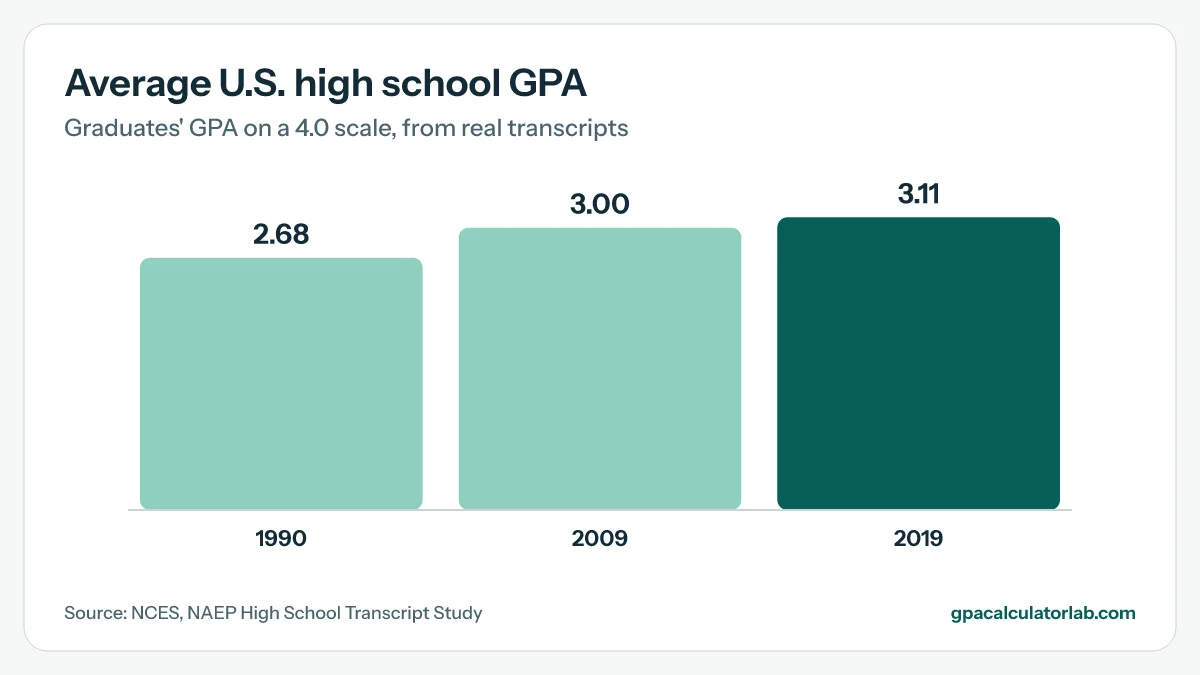
The federal High School Transcript Study collects real transcripts from a national sample of graduates. In 2019 the average GPA was 3.11, up from 3.00 in 2009 and 2.68 in 1990. Grades have risen over time, so a 3.0 today is a little below the national average rather than above it.
Source: NCES High School Transcript Study.
Is a 3.0 GPA good?
A 3.0 is a solid B average and just under the 3.11 national average. It meets the University of California's 3.0 minimum for California residents, but not the 3.4 it asks of nonresidents. In college, a 3.0 is well above the C average you need to keep federal financial aid.
Is a 3.5 GPA good?
Yes, for most purposes. A 3.5 is above the national average and clears both UC minimums. At highly selective colleges it can sit below the middle of the incoming class, so compare it with the GPA ranges each college publishes in its Common Data Set.
Is a 3.7 or 3.8 GPA good?
A 3.7 is an A− average and a 3.8 is close to it. Both are strong numbers almost anywhere. For the most selective schools, look at the GPA spread of the students they admitted rather than a general rule, and check whether they report weighted or unweighted GPAs.
Is a 4.0 GPA good?
An unweighted 4.0 means an A in every class, so it can't go higher. A weighted 4.0 is different: it can include B's that were lifted by AP or Honors bonus points. Know which one you have before you compare it with anyone else's.
Is a 2.5 GPA good?
A 2.5 sits between a C+ and a B− average. It is above the 2.0 floor for federal aid and good standing at many colleges, but below UC's 3.0 minimum and below many scholarship cutoffs. The good news is that a 2.5 early on moves quickly: see how to raise your GPA for the math.
Minimums that actually matter
- Federal financial aid: in programs longer than two years, you need at least a C average (a 2.0) by the end of your second academic year, or academic standing your college accepts for graduation. Source: 34 CFR 668.34.
- University of California: at least 3.0 for California residents and 3.4 for nonresidents, in A-G courses. UC calculates it its own way, so use the UC GPA calculator.
- Scholarships, honors programs and majors set their own minimums. Read the exact requirement, including whether it uses a weighted or unweighted GPA.
Check your own number
Your GPA depends on credits as well as grades, so two students with the same letters can end up with different numbers. Enter your classes in the GPA calculator for a quick answer, the high school GPA calculator to see weighted and unweighted side by side, or the college GPA calculator for credit hours and retakes.
What GPA do scholarships ask for?
Merit scholarships publish exact cutoffs, and they're often higher than college admission minimums. Florida's Bright Futures program is a clear example. The Florida Academic Scholars award requires a 3.5 weighted GPA in 16 college-prep credits, and renewing it in college takes a 3.0 cumulative GPA. The Florida Medallion Scholars award starts at a 3.0 weighted GPA. Bright Futures recalculates that GPA itself, adding 0.5 for Honors, AP, IB and dual enrollment courses.
Sources: Florida Statutes 1009.534, Collier County Public Schools: Bright Futures, Broward County Public Schools: Bright Futures requirements.
Check whether a scholarship wants a weighted or an unweighted GPA, and whether it uses your school's number or recalculates it.
What GPA do you need for graduate school?
Many graduate programs list 3.0 as the floor. UC Berkeley's Graduate Division, for example, asks for a satisfactory average, usually at least a 3.0 (B) on a 4.0 scale. Individual departments can set higher bars, and a minimum is where a program starts reading, not the GPA most admitted students have. Source: UC Berkeley Graduate Division: Admissions requirements.
For law school the number that matters is the LSAC GPA, which counts every attempt at a repeated class and gives an A+ 4.33. The law school GPA calculator shows how yours compares with your college GPA.
How to read a college's GPA profile
Most colleges publish a Common Data Set each year. Section C11 shows what share of the incoming class had GPAs in each band, and C12 gives their average high school GPA. These are the best numbers to compare yourself with, but read them carefully. Colleges don't all report the same kind of GPA: Auburn University's 2024 Common Data Set lists an average of 4.09, which can only be a weighted figure. Source: Auburn University Common Data Set 2024, Section C.
Before you compare, check whether the college's number is weighted, and compare it with the same kind of GPA from your own transcript.
Frequently asked questions
What is the average high school GPA?
3.11, according to the 2019 High School Transcript Study, which used transcripts from a national sample of graduates. It was 3.00 in 2009.
Can a GPA be higher than 4.0?
A weighted GPA can, because Honors, AP and IB classes earn bonus points. An unweighted GPA stops at 4.0 on the standard scale.
Do colleges look at weighted or unweighted GPA?
It depends on the college. Many read the GPA your school reports and also look at which classes you took. Some, including the University of California, recalculate your GPA with their own rules.